
Academia & Research resume samples
Selection committees at Indian colleges and universities read a faculty application for eligibility first: PhD status, a UGC NET, CSIR NET or SET result, and the subjects you have taught. Publications come next, with the journal name, indexing and a DOI for each, often backed by an ORCID iD or a Google Scholar profile. Funded projects, labs you ran and students you guided also count.
Two assistant professor samples sit here, one in computer science and one in mechanical engineering, along with a teaching-focused professor sample built on curriculum leadership and supervision. The graduate school and MBA application samples are written for admissions readers instead. They show research, a capstone, work progression and community leadership in a short format that matches what a statement of purpose claims.
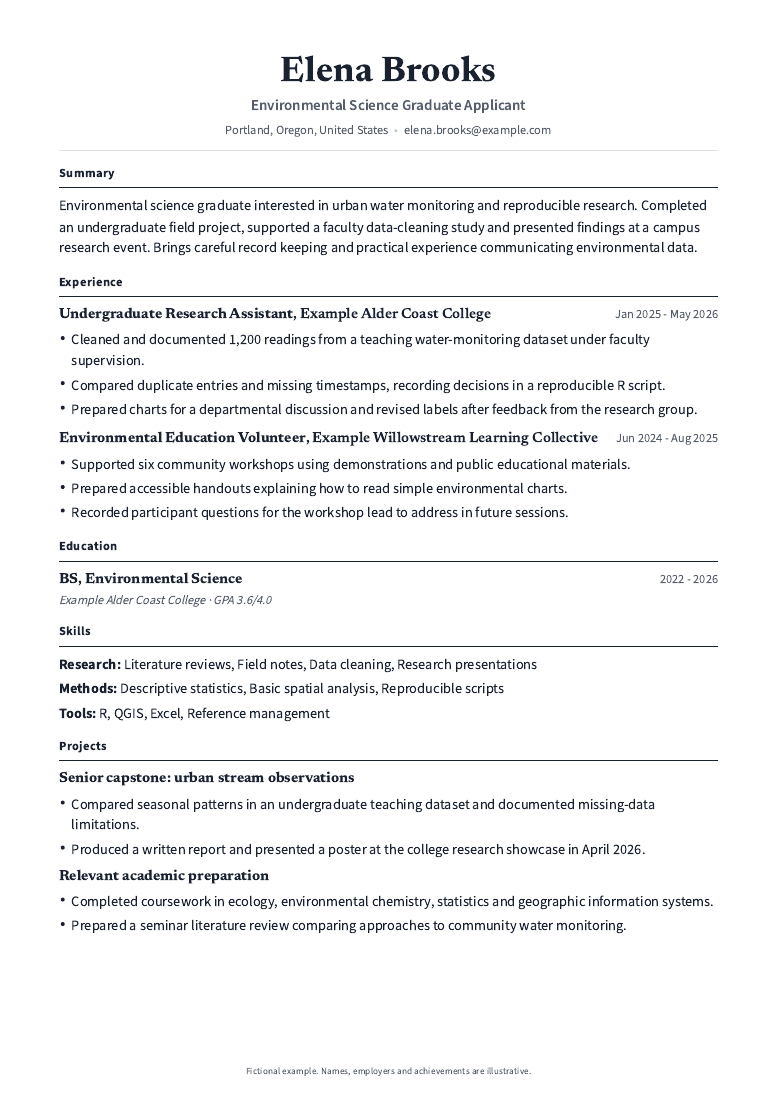
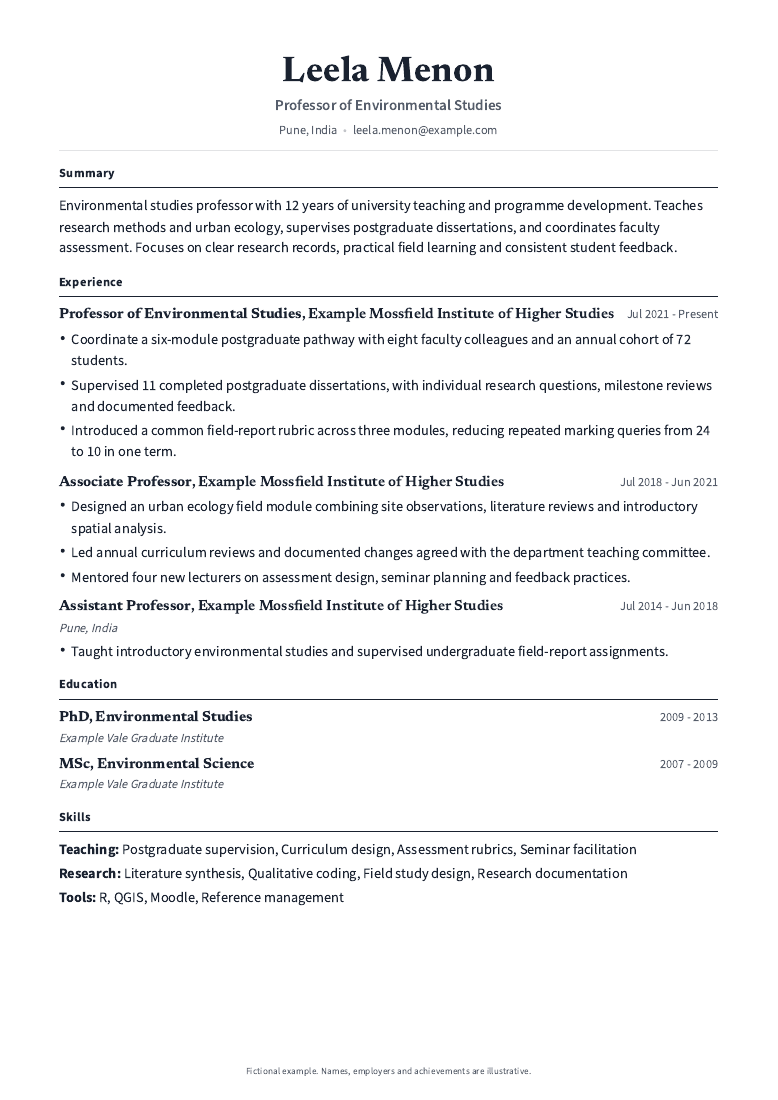
5 samples, Environmental Science Graduate Applicant, Professor of Environmental Studies, MBA Applicant, Assistant Professor. Each is a complete resume rendered as text on its own page, not a screenshot of one, and they run from fresher to senior.
The academia & research samples
- Environmental Science Graduate Applicant
Graduate School Application Resume Sample
Academia & ResearchFresher - Professor of Environmental Studies
Professor Resume Sample and Format
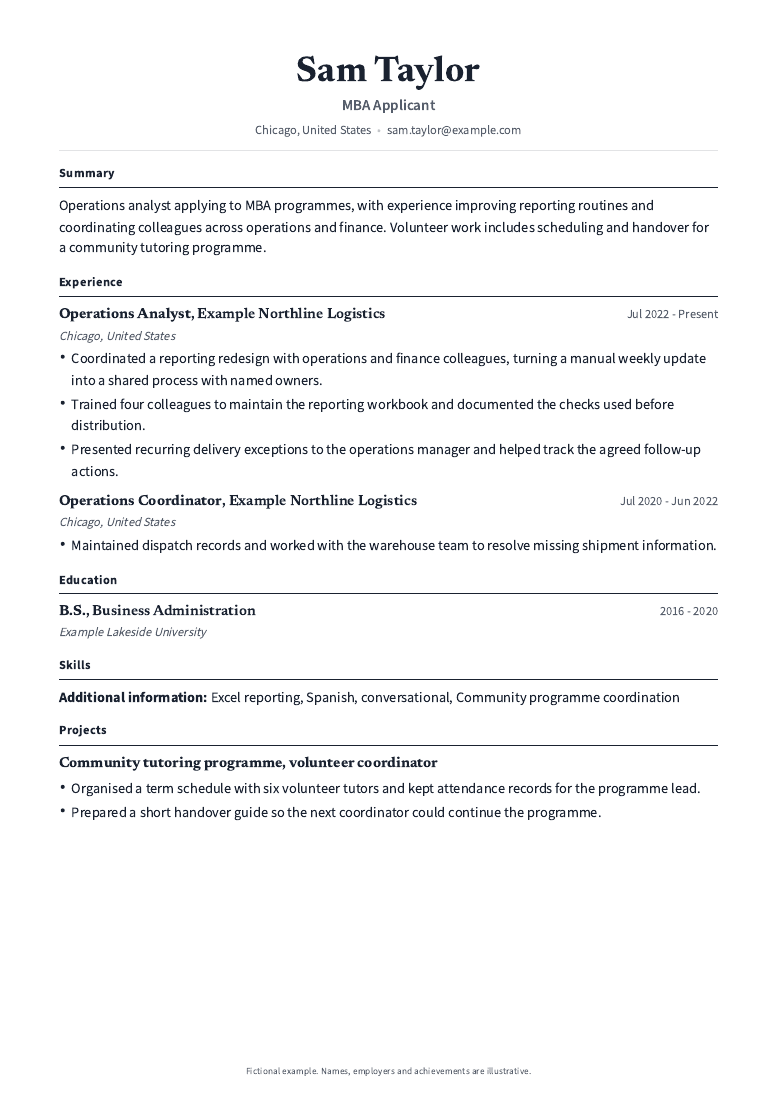
Academia & ResearchSenior - MBA Applicant
MBA Application Resume Sample
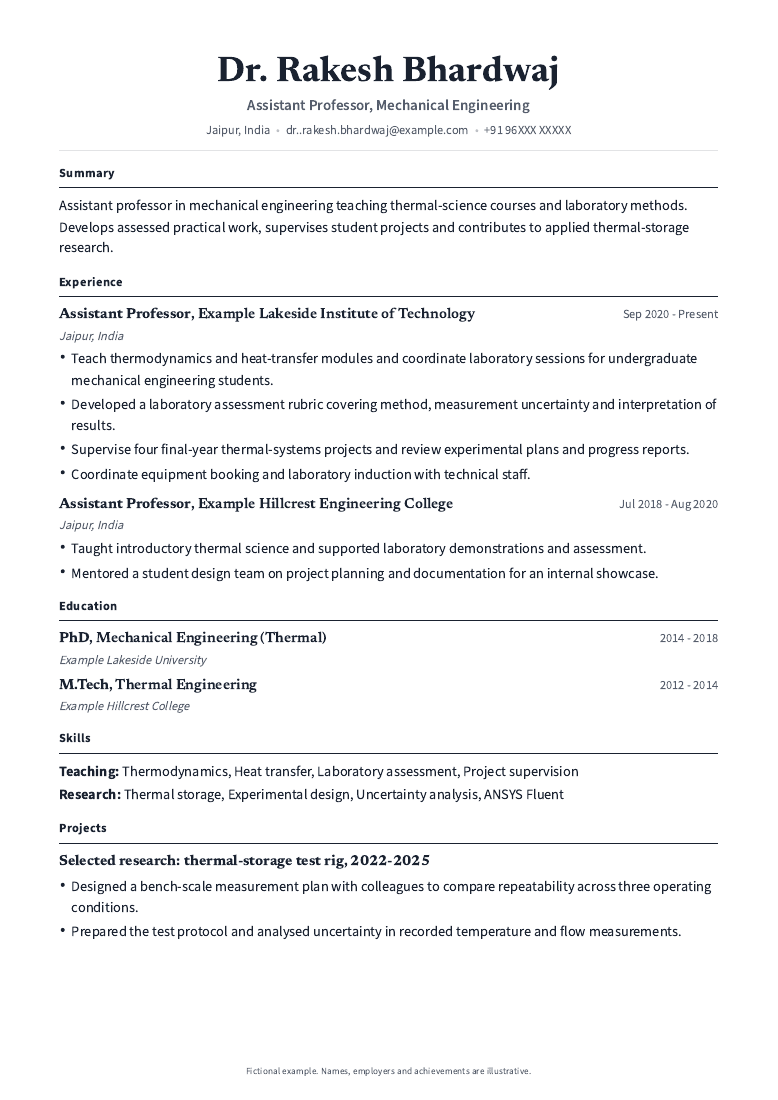
Academia & ResearchMid-Level - Assistant Professor
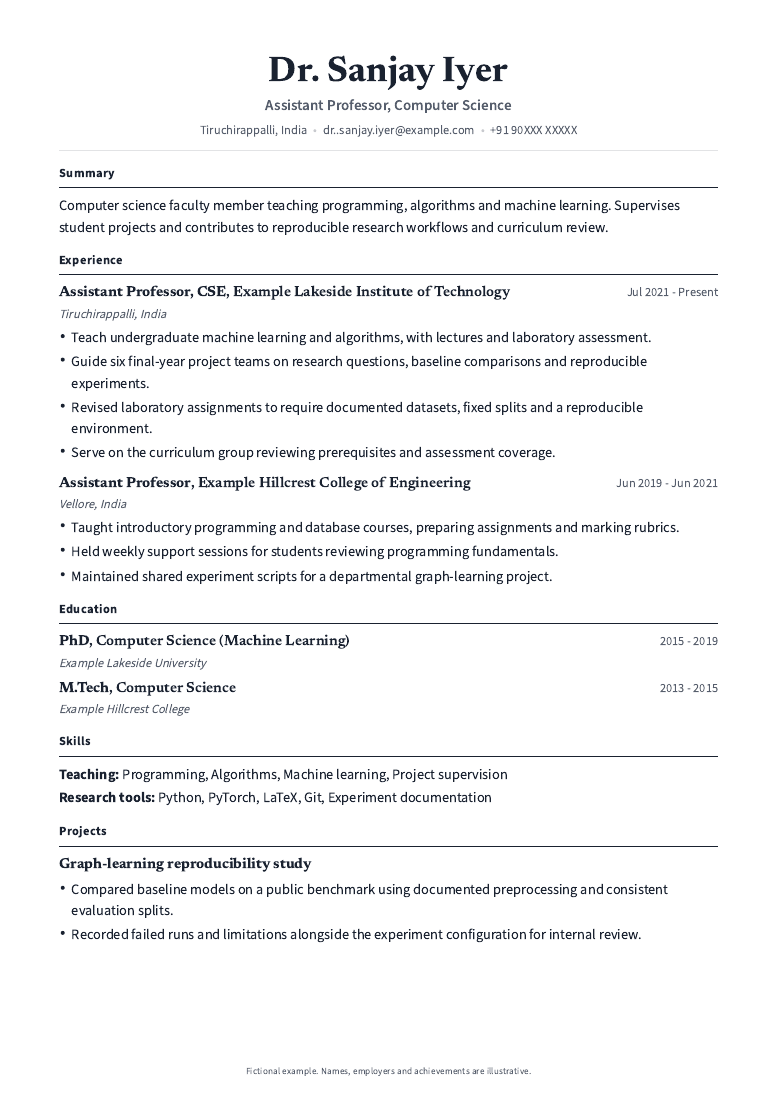
Assistant Professor Resume Sample and Format
Academia & ResearchSenior - Assistant Professor
Assistant Professor Resume Sample
Academia & ResearchMid-Level
Skills that repeat across these academia & research samples
These 4 terms appear on at least two of the 5 samples above. That is the whole claim: not what the field is supposed to want, but what these documents actually share.
- Project supervision ×2
- QGIS ×2
- R ×2
- Reference management ×2
What to leave off an Indian academia & research resume
None of the 5 samples above carries a photograph, a date of birth, a marital status or a declaration line, and that is the single biggest difference between a resume written for an Indian employer in 2019 and one written for the shortlist today.
- The photograph, unless an employer explicitly asks for one.
- Date of birth, age, gender and marital status. None of them predict the work.
- Father's or husband's name, a form field, not a resume line.
- The full postal address. The city is what a recruiter filters on.
- Current and expected CTC. It is a negotiation, not a qualification.
- The declaration paragraph and the signature block at the end.
What replaces them is space: another two bullets of work that can be measured. The free review flags these on your own resume.
By experience level
Fields that hire for the same skills
Questions about academia & research resumes
Do Indian colleges want an academic CV or a short resume for assistant professor posts?
Most ask for a full academic CV, often on their own application form. It lists every publication, conference paper, funded project, student you guided and administrative duty, so it can run past four pages. A two-page resume suits a first screen or an industry role. The assistant professor samples here show the short version, with guidance on what to expand into a full CV.
How should publications be listed on a faculty resume?
Pick one citation style, such as APA or IEEE, and use it throughout. Give authors in the published order, then the title, journal, volume, year and DOI. Say a journal is Scopus or Web of Science indexed only if it is. Keep journal articles, conference papers, book chapters and patents in separate lists, and put papers under review in their own clearly labelled list.
How long should a graduate school application resume be?
One to two pages works for most master's and PhD applications, unless the university sets its own limit. Lead with education and research. For each project, give the question, the method, your own part and any output, such as a thesis, poster or dataset. The graduate school sample keeps its community education work short, so the environmental research gets the most space.
What does an MBA admissions committee look for on an application resume?
Most business schools ask for one page. Readers want to see your responsibility grow from role to role, with results you can explain in an interview, plus leadership outside work. Write for someone outside your industry: replace internal team names and jargon with plain descriptions. The MBA application sample shows how one reporting project and community leadership were chosen as evidence.
Build your Career Story.
Build a Career Story from your experience, then use it to draft and review your application documents.