48 Resume Action Verbs With Worked Examples
Choose accurate resume verbs for analysis, building, coordination and support. Includes fictional bullets and guidance on responsibility and results.
Choose a verb that accurately describes your contribution. The rest of the bullet should explain the task, context and result. A stronger-sounding verb cannot turn a supporting role into leadership or establish that an employer’s screening system will accept the resume.
48 verbs grouped by task
These groups help you find a precise word. They are not a checklist to insert into every resume. Reusing an accurate verb is better than choosing an unfamiliar synonym that changes the meaning.
Analysis
Analysed, Compared, Investigated, Reconciled, Validated, Measured, Calculated, Mapped.
Building and implementation
Built, Designed, Developed, Configured, Implemented, Integrated, Tested, Documented.
Coordination
Coordinated, Scheduled, Organised, Tracked, Maintained, Prepared, Updated, Recorded.
Communication
Explained, Presented, Wrote, Edited, Summarised, Clarified, Reported, Translated.
Leadership and support
Led, Supervised, Coached, Trained, Mentored, Supported, Assisted, Facilitated.
Improvement and delivery
Reduced, Improved, Simplified, Automated, Resolved, Delivered, Launched, Negotiated.
Turn the verb into evidence
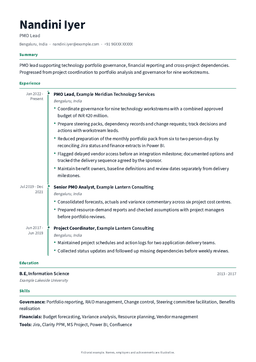
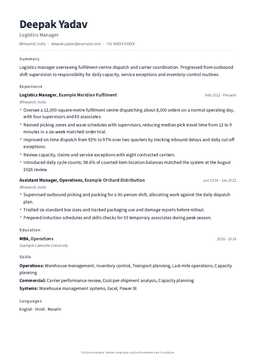
Fictional analysis example: “Reconciled weekly stock counts with the warehouse register and referred unmatched movements to the supervisor.” The useful information is what was compared and how exceptions were handled.
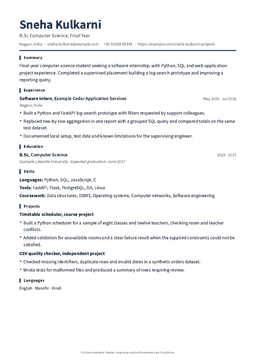
Fictional engineering example: “Implemented booking validation in a student equipment-reservation project and tested overlapping requests.” The educational setting and actual technical contribution are clear.
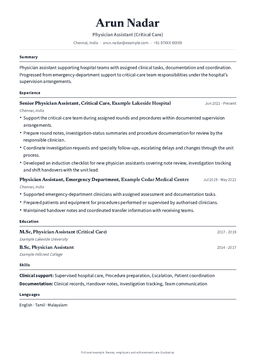
Fictional support example: “Assisted the finance manager by checking invoice references against purchase orders and recording missing documents.” “Assisted” is accurate here because the candidate supported a defined task.
Use results you can explain
If a measured result exists, state the basis and your contribution. Fictional example: “Reduced the weekly report preparation time from three hours to two by automating the duplicate-record check.” Be ready to explain how the times were measured and whether the comparison covered equivalent work.
When you have no defensible metric, describe the completed output, scope or improvement. Do not create a percentage merely because a template expects one.
Match tense and responsibility
Use past tense for completed work and present tense for ongoing responsibilities where appropriate. Keep tense consistent within a description. Use “led” when you directed the work, “coordinated” when you organised its parts and “supported” when you contributed under someone else’s responsibility.
Avoid claiming that a verb improves an ATS score by itself. Relevant role terminology can make your experience clearer, but there is no universal ranking benefit attached to a list of action words.