Google Docs Resume Templates: Edit and Export Carefully
Choose a Google Docs resume layout, replace the example content and check the exported file. Follow a practical editing workflow without unsupported ATS claims.
A Google Docs resume template can give you a starting layout, but it still needs your own content and a careful export check. Choose a design you can edit comfortably, then replace every sample detail. A template's name or appearance does not guarantee compatibility with every applicant tracking system. The employer's requested file type and the clarity of your information matter more than a decorative label.
Create a working copy and export it
On a computer, open Google Docs and select Template Gallery at the top right. Select a resume template to create a copy. Rename the copy for your target role, replace the sample details and remove unused sections. If you already have a document to reuse, choose File, then Make a copy.
When the document is ready, choose File, then Download and select the file type the employer accepts. Open that downloaded file to check page breaks, missing text and links. The editable document and the exported file need separate checks.
Start with an editable copy
Google's template help explains how to use templates in its editors. Available templates and controls can vary by account or organisation. If you use a shared document from another source, check that you are allowed to copy and adapt it. Work in your own copy so you do not edit the original or expose personal information to its owner unnecessarily.
Give the working file a clear name. Keep a general master version and create a separate copy for a specific application when the content changes substantially. That makes it easier to recover an earlier version and remember what you submitted.
Choose a layout around your content
Look for readable text, obvious section headings and enough space for your strongest evidence. A layout designed for a short student history may be awkward for a senior specialist. Conversely, an elaborate two-page template may leave a graduate application full of empty sections. Choose the simplest structure that presents your information clearly.
Do not reduce the font until everything fits at any cost. Shorten repeated responsibilities and remove irrelevant material first. Keep enough spacing for the reader to distinguish employers, titles and dates. A page that looks tidy at a reduced zoom may still be difficult to read at normal size.
Replace the sample content methodically
Start with your name and contact information, then education, experience and skills. Remove sample addresses, links, awards and filler text. Check headers and footers as well as the main body. If a template contains a photograph or a personal-information field, decide whether it is appropriate to the application instead of copying it automatically.
Use real evidence in the bullets. An original fictional example is: Checked weekly order records for missing references and prepared an exception list for the supervisor. That explains a task and output without a vague claim of excellence. Replace it with your own contribution and keep any number traceable to a genuine measurement.
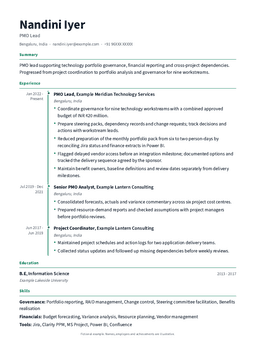
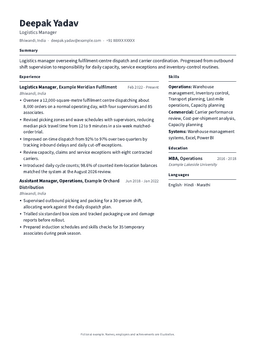
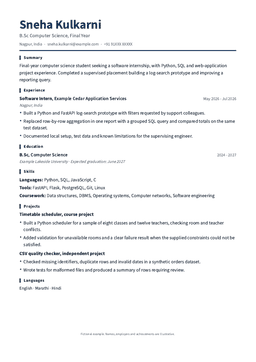
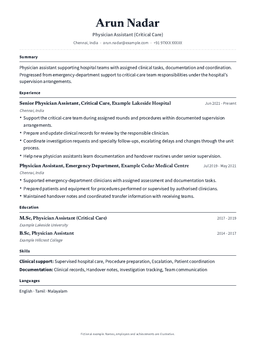
A simple resume structure you can copy
The following candidate, institutions, employer and achievements are fictional. Copy the structure into a blank document, then replace every detail. The wording is a starting example, not a downloadable Word file or a claim about a real person.
Asha Rao | Operations Graduate | Pune, India | asha.rao@example.com
Summary: Commerce graduate with placement experience maintaining order records and preparing spreadsheet reports. Seeking an operations role where careful record checking and clear team handovers are useful.
Experience: Operations Intern, Example Cedar Services, Pune | January 2026 to April 2026. Checked incoming order records for missing references and prepared a weekly exception list for supervisor review. Updated the shared action register after team meetings and confirmed ownership of unresolved entries.
Project: College event registration, 2025. Coordinated a four-person registration desk, checked duplicate entries in the attendee spreadsheet and prepared the final attendance summary using the team's agreed categories.
Education: BCom, Example Rivergate College | 2023 to 2026.
Skills: Spreadsheet formulas and filters, record checking, meeting notes, registration coordination and written handovers.
This compact structure works as an editing exercise in Google Docs or Word. Give each section a clear heading and turn the experience sentences into separate bullets. Add only qualifications and skills you can support. If you need a Word file, choose the appropriate export option in your editor and check the downloaded document; changing the file extension alone does not convert a PDF into an editable Word document.
For a more experienced application, replace the student project with relevant recent employment. For a fresher without a placement, use a clearly labelled coursework or volunteering example. Do not keep a fictional internship to fill space. The useful part of a template is its organisation, while the evidence must come from you.
Keep styling consistent
Use one date style, a consistent heading hierarchy and a limited set of text sizes. Avoid aligning important information with repeated spaces, which can shift when text changes. When you paste content from another source, check that it has not introduced a different font or unexpected spacing. Review the page after editing a long title or employer name.
If a template relies heavily on tables or columns, inspect the reading order of the exported file. Copying the text into a plain document can reveal obvious ordering problems. This is a useful check, not proof that every recruitment system will read it correctly.
Export the format the employer requests
Google's download instructions describe using File, then Download, and choosing a file type. Use the format named in the vacancy. A PDF can preserve the intended layout; an employer may instead request a Word document. Open the downloaded file in a suitable viewer and inspect the actual output, especially if you changed the page size or used a complex layout.
Do not send only a Google Docs link when the application asks for an attachment. If a link is requested, check recipient access and avoid sharing a whole folder. Review comments and suggested edits before giving someone access to the working document. A private note to yourself should not become part of the application.
Run a final application check
Confirm the role-specific summary, dates, spelling, contact links and attachment name. Look for a heading stranded at the bottom of a page or a short second page caused by one extra line. Fix the content or spacing deliberately rather than inserting repeated blank lines. Keep the exported version alongside the application record.
CareerOS offers its own resume templates; those are separate from Google's template collection. This guide does not provide a native Google Docs template or claim that a CareerOS export preserves every Google Docs feature. Use the resume section guide to improve the content whichever editor you choose, and review your resume before submitting it.