Resume Sections, Profile Summaries and Career Objectives
See what belongs in each resume section, with fresher profile summaries, experienced career objectives and examples you can adapt honestly.
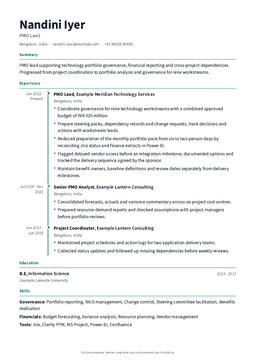
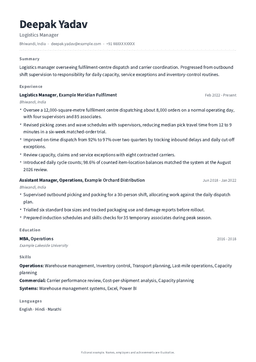
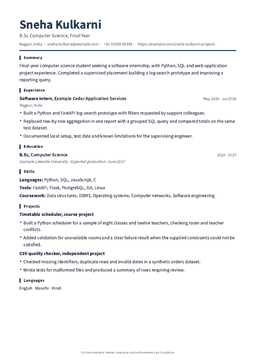
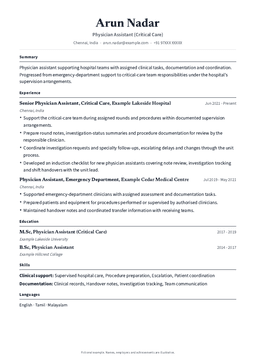
Resume and candidate examples in this guide are fictional illustrations, including their organisations, achievements and figures. Use the writing approach with your own accurate details; these are not verified customer outcomes.
Common resume sections are contact details, a relevant summary, experience, education and skills. Add projects, internships, certifications or other sections when they help explain your suitability. Follow any prescribed application format; a general-purpose resume usually needs no closing declaration or signature.
This guide explains what each section contributes and how to choose useful evidence.
Header
Start with your name, a working phone number and email, location, and relevant professional or portfolio links. Include the details needed for this application, without treating every possible field as mandatory.
- Email: `firstname.lastname@gmail.com`. Not the college address you will lose access to, and not a nickname.
Phone: include a country code when it helps an international reader contact you.
Location: city and country or region as appropriate; a full street address is usually unnecessary for an initial resume.
LinkedIn or portfolio: use a readable link and check that it opens. Showing a short URL can help when the document is printed. Do not assume every parser handles links in the same way.
- GitHub, portfolio, Behance: same rule, and only where the work is real and current.
Keep essential contact details in the main document text. Some parsers can have difficulty with headers or footers, so inspect the exported file and any editable fields after upload.
Summary
A short introduction near the top of the page helps the reader understand the experience that follows.
A summary states three things: what you are, your strongest evidence, and what you are targeting.
> Operations analyst with four years in third-party logistics, managing dispatch planning for a 40-vehicle fleet across three states. Cut average delivery exceptions by 22% by rebuilding the route exception workflow. Looking for a supply chain analyst role in a product or e-commerce company.
What makes that work is that every clause is checkable. Compare it with the version most resumes carry:
> A hardworking and dedicated professional with excellent communication skills seeking a challenging position in a reputed organisation where I can utilise my skills for the growth of the company.
That sentence describes nobody. It could appear on many different resumes without revealing who the applicant is.
For freshers, the summary carries what you have instead of a work history: your degree, your strongest project or internship, and the specific role you want.
> B.Tech mechanical engineering graduate, 2026, Example Institute. Built and tested a CFD model of a heat exchanger as a final-year project, cutting simulation runtime by a third. Targeting design engineer roles in automotive or HVAC.
Objective, and whether you still need one
An objective states what you want. A summary states what you offer. For many experienced applicants, a relevant summary is more useful because it introduces what they can contribute. A targeted objective can help explain a change of direction or answer a specific application field.
An objective can clarify a first application, a change of direction or a requested form field. Use it when it adds context that the rest of the opening does not already provide.
When you do write one, make it specific to the role. A sales objective that says "seeking a challenging sales position" is filler. One that says "Field sales role in FMCG distribution across Maharashtra, building on two years of general trade coverage in Pune" is a claim.
Work experience
A central section for applicants with relevant employment experience. Reverse chronological. For each role: company, your title, location, and start and end dates as month and year.
Use enough concise bullets to explain the relevant work. A useful starting structure is:
action verb + what you did + how + the result.
- Weak: "Responsible for managing social media accounts."
- Strong: "Ran Instagram and LinkedIn for a D2C skincare brand, growing followers from 4K to 31K in eleven months through a three-post-a-week reels cadence."
Verbs that work: Led, Built, Delivered, Drove, Managed, Developed, Designed, Launched, Reduced, Increased, Implemented, Negotiated, Secured, Streamlined.
Use verbs that reflect your responsibility. “Assisted” can be accurate and useful when followed by the specific task you completed. Do not replace it with “led” unless you led the work.
Quantify wherever the number exists. Team size, budget, revenue, ticket volume, percentage improvement, number of clients, project value. "Managed a large team" invites the question. "Managed 14 people across two shifts" answers it.
Not everything is measurable, and inventing a number is worse than not having one. Where there is no metric, name the scale or the stakes instead: the system, the client, the region, the deadline.
Education
Degree, institution, year of completion. Percentage or CGPA while you are a fresher or where it is genuinely strong.
Shorten older education details as relevant work becomes more important. Keep qualifications or marks requested by the application; there is no universal time threshold for removing them.
Skills
Group them. A single comma-separated paragraph of thirty items is unreadable and tells a recruiter nothing about depth.
> Data: SQL, Python (pandas, scikit-learn), Power BI > Cloud: AWS (S3, Lambda, Redshift) > Process: A/B testing, cohort analysis, experiment design
List skills you can explain and demonstrate at the level claimed. Include document formatting or email handling when relevant to the role, with concrete examples rather than an unsupported proficiency label.
Projects
For freshers, students and career changers, projects are the experience section. Write them like jobs: what the problem was, what you built, the tools, and the outcome.
For experienced candidates, a project section is worth having only when the work is not visible in the job bullets, typically open-source contributions, freelance work, or a side product with real users.
Internships
An internship is work experience. Put it in the work experience section, with the same structure as a job, and label it "Intern" in the title.
The mistake is writing it as a certificate: "Completed a six-week internship at ABC Ltd." That says a duration and a company name. Write what you did instead: what you were given, what you produced, and what happened to it.
> Marketing Intern, Example Foods, Pune, May 2025 to July 2025 > Ran the competitor pricing tracker across 60 SKUs in modern trade, and produced the monthly price-gap report the category team used to set promotions.
Shorten older education details as relevant work becomes more important. Keep qualifications or marks requested by the application; there is no universal time threshold for removing them.
Extracurricular activities
Include extracurricular or volunteer work when it shows relevant responsibility or sustained contribution. Its value depends on the application, not solely on how long you have been employed.
Write them with the same specificity as everything else. "Cultural secretary, college fest, coordinated 40 volunteers and a budget of ₹3.2 lakh across three days" is evidence. "Member of the cultural committee" is a line of text.
Interests can be omitted when they add no useful context. Relevant participation, leadership or a portfolio of work may deserve a brief entry.
Additional information
The section that collects what has nowhere else to go: languages, publications, patents, awards, volunteering, professional memberships, and work authorisation where it genuinely matters.
Use additional information when it helps assess this application. A language can matter in technical as well as customer-facing work if the team or vacancy requires it. Explain relevant awards or memberships without assuming their value is obvious.
Avoid unnecessary identity numbers, family details and personal-status fields in a general resume. Follow explicit application requirements separately and read the personal-details guide for context.
How to end a resume
You do not. The resume ends on its last piece of real content, usually skills, certifications or additional information.
Three things people add at the bottom and should delete:
A generic declaration usually adds no evidence to a general resume. If a prescribed application requires a declaration, use the requested wording and verify the facts before signing.
- A signature and place. This is an application-form convention, not a resume convention.
- "References available on request." Assumed. It spends a line saying nothing.
If you want the last line of the resume to do work, make it your strongest certification or your clearest evidence of currency in the field.
Check what each section is actually scoring
A resume review can suggest content and structure changes. Check the feedback yourself; it cannot reproduce every employer’s parser or predict a hiring decision.
For the shape of a strong section in your own field, the resume samples library has published examples by role and by experience level.
Profile summary for freshers: examples by role
A fresher profile summary can describe useful work even when you have not held a full-time job. Use your qualification or current stage, the relevant capability you have practised and the type of role you are applying for. The summary should help someone understand the evidence that follows. It should not introduce achievements that appear nowhere else on the page.
All examples in this section describe fictional candidates. They show a way of writing, not qualifications or results that readers should claim. Replace every detail with something you can explain and substantiate. A shorter, accurate summary is more useful than copying an impressive example that does not describe your background.
Commerce and accounts example
B.Com graduate with coursework in financial accounting and practical Excel experience from a student society budget project. Reconciled receipts against an expense tracker and prepared a category-level spending summary for the committee. Seeking an accounts assistant role where careful checking and clear records matter.
This example does not pretend that a student project was a paid finance job. If you have an accounts internship, replace the coursework emphasis with the actual tasks and software you used. If your experience is limited to a classroom exercise, label that context rather than implying you managed an employer's accounts.
Software and technology example
Computer science graduate who built a small equipment-booking application using JavaScript, React and a SQL database. Implemented booking validation, wrote tests for overlapping requests and documented the setup for classmates. Interested in a junior software role involving accessible interfaces and reliable data handling.
The summary names what the candidate built and one engineering decision. It does not call the project enterprise-scale or production-ready without evidence. If your work was a tutorial adaptation, explain what you changed, tested or investigated yourself. Keep repository links current and remove credentials or private data before sharing code.
HR and operations example
Business graduate with experience coordinating a campus mentoring programme. Maintained participant records, scheduled sessions and wrote reminder messages for students and mentors. Seeking an HR operations assistant role that uses organisation, accurate records and considerate communication.
The role title is a target, not a claim that the candidate has already held it. This matters when applying for a first job. Keep administrative experience specific and avoid implying responsibility for employment decisions, payroll or confidential employee cases if those tasks were outside your role.
Career objective for an experienced resume
An experienced candidate can usually start with a summary of relevant work. An objective can still be useful when the direction would otherwise be unclear, or when an application specifically asks for one. Combine the next step with evidence you already have. The reader should understand both why you are applying and what transfers to the new work.
A weak version says: Seeking a challenging position in a reputed company to utilise my skills. A more useful fictional example says: Customer support team lead moving into service operations, bringing four years of escalation handling, coaching and queue reporting. Interested in improving support processes through clearer handoffs and better operational reporting.
The second version explains a move without claiming the candidate is already an operations manager. If you are staying in the same field, a direct summary may be simpler: Warehouse supervisor with five years of shift coordination, stock reconciliation and dispatch planning. Experienced in training new starters and maintaining clear handover records between teams.
An objective for a career change
Suppose a fictional teacher is applying for a learning coordinator role. A grounded opening could read: Teacher moving into workplace learning coordination, with experience planning sessions, adapting explanations and tracking learner progress. Seeking a role supporting training delivery, scheduling and useful learning materials.
The transferable experience is clear, but the wording does not pretend classroom work automatically equals corporate learning-and-development experience. The rest of the resume should show examples of planning, coordination and feedback. Add relevant training or a portfolio exercise separately if you have completed it.
Returning after a career break
You can focus on your relevant experience and current readiness without sharing personal details you do not want to disclose. A fictional example: Administrative professional returning to office coordination after a career break, with previous experience in scheduling, invoice tracking and supplier communication. Recently refreshed spreadsheet skills through a practical reporting course.
Use recently refreshed only if you can name the completed work. You do not need to call a break a consulting role or invent freelance clients to fill the dates. A brief factual explanation and current evidence make it easier to discuss the transition honestly.
Write the summary after the main sections
Draft your experience and project bullets first. Then identify the two or three facts most relevant to the target job. The summary is an introduction to those facts, not a separate sales pitch. Read it beside the job description and remove any sentence that could apply equally to almost every applicant.
Check dates, years of experience, tools and results against the rest of the document. Avoid upgrading assisted to led simply to make the opening sound stronger. Shared work can still be useful evidence when your contribution is clear. If you have no suitable evidence for a claim, remove the claim and strengthen a project instead.
Write your summary from the evidence in the completed resume. For a longer change of direction, explain the relevant transferable work and any additional preparation. Neither a summary template nor a keyword match guarantees an interview.