Skills for a Fresher Resume: Examples You Can Prove
Choose relevant fresher resume skills, support them with project evidence and describe your level honestly, with examples for different roles.
The best skills for a fresher resume are the ones a particular job needs and your own work can support. You do not need a long list of impressive-sounding tools. You need a short, credible set of capabilities and a project, placement, volunteering activity or other example that shows you using them.
Start with the job description, then compare it with what you have actually done. If a vacancy asks for Excel, customer communication and accurate record keeping, a list headed Python, leadership and creativity may miss the work even if every item is true. The skill list should help the reader connect you to this role.
Make an evidence list before choosing words
Create three columns: task you completed, skill used and evidence you can discuss. A college event budget might give you spreadsheet formulas, supplier communication and reconciliation. A research project might give you source evaluation, data cleaning and report writing. A part-time shop role might give you stock checks, customer questions and payment handling.
Keep the scope honest. Organising a student society budget does not make you a corporate finance specialist. It can still demonstrate that you checked receipts, reconciled differences and explained spending to others. Good wording makes the activity understandable without inflating the level of responsibility.
Technical skills: name the task as well as the tool
For an accounts assistant application, a useful line could be: Excel, including SUMIFS, lookup formulas and pivot tables; invoice checking; basic bank reconciliation. Under a project or placement, explain how you used those skills. If you have only practised with a fictional dataset, label the work as a coursework exercise rather than client accounting.
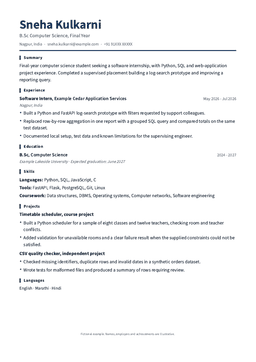
For a junior software role, consider the language, framework, version control and testing tools you used on a real project. JavaScript, React, Git and unit testing is easier to understand when a project bullet explains the interface you built and the errors your tests checked. Avoid listing every technology installed during a tutorial.
For a marketing role, relevant evidence might involve content planning, spreadsheet reporting, audience research or a campaign experiment. If you have never managed a paid budget, do not list paid media management because you watched a course. You can list the completed course under training and describe any practical exercise separately.
People skills need a situation
Communication, teamwork and problem-solving are useful words, but they tell little by themselves. Replace a claim such as excellent communication with an example: explained registration changes to thirty event volunteers and wrote a one-page briefing they could use during check-in. The number is appropriate only if it is true for your activity.
For teamwork, say what you owned and how you coordinated it. For problem-solving, describe the obstacle and the decision you made. For organisation, give the work, deadline and tracking method. You do not need a dramatic result. A clear account of completing a modest responsibility is stronger than an unsupported claim of exceptional leadership.
Role-specific skills examples
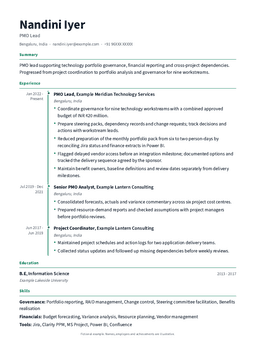
The following are fictional learning examples, not ready-made claims to copy. An entry-level HR candidate might list interview scheduling, spreadsheet trackers, document checks and written communication, then show how they coordinated mock interviews for a campus society. They should not claim employee-relations expertise from that activity.
A customer service applicant might list email writing, issue classification, order-system familiarity and language proficiency. Evidence could come from a part-time retail role or supervised support placement. Distinguish the channels you used: answering in-person questions is relevant, but it is not the same experience as handling a live chat queue.
A data analyst fresher might list SQL joins, Excel cleaning, a visualisation tool and basic statistical summaries. A project should identify the dataset, the question and the checks performed. Showing that you found duplicate records and corrected a misleading chart can be useful evidence even when the project never reached a commercial user.
An office or data-entry applicant can include typing, document formatting and spreadsheet work when the vacancy asks for them. Basic software should not be dismissed automatically. Describe the relevant tasks and report a typing speed only when you can explain the test conditions, accuracy and date of the assessment.
Show your level without skill bars
A coloured bar saying ninety per cent Excel has no shared meaning. Instead, use a task-level description such as built pivot summaries for a coursework dataset or used SQL joins in two academic projects. If your experience is introductory, say so when necessary. You can demonstrate progress without describing yourself as an expert.
Separate skills you can use now from skills you are learning. A course in progress belongs under training with its status. Do not place a certification after your name until you have earned it. If a tool is important to the role but you have not used it, acknowledge the gap and plan an exercise rather than hiding it behind a keyword.
Put the evidence in the rest of the resume
Imagine a fictional student applying for an operations internship. The skills section says Excel and stock reconciliation. A matching project bullet reads: compared the student society's equipment register with a physical count, identified missing serial numbers and produced a corrected issue-and-return sheet. The bullet supports the skills without inventing a financial saving.
Use the same check for every shortlisted skill: where does the reader see evidence? You do not need a separate bullet for each word, but a list with no connection to your projects feels unfinished. Remove marginal items to make space for a stronger explanation of work that matters to the vacancy.
Adapt to the application, not a country stereotype
For Indian campus recruitment, follow a mandatory placement-cell format and include requested academic information. For other applications, follow the employer's instructions about documents, length and supporting statements. The evidence should remain consistent across an Indian resume, a UK CV or a US resume, even if the format changes.
The National Careers Service CV guide recommends matching a CV to the advertised role. Our practical extension is to keep an evidence note beside each selected skill so you can explain it in an interview.
Choose skills from the vacancy that you can demonstrate through a project, course or work example. Place that evidence beside the relevant experience so the reader can see how you used the skill.