Fresher Resume Guide: Write a Resume With No Experience
Build a fresher resume using real projects, education and activities, with a complete fictional example and guidance for applications with no work history.
Resume and candidate examples in this guide are fictional illustrations, including their organisations, achievements and figures. Use the writing approach with your own accurate details; these are not verified customer outcomes.
A first resume can include contact details, a relevant summary, education, projects, internships or training, and skills. Choose the sections that show evidence for the target role. Follow a required application format when one is provided. You do not need to invent employment to demonstrate useful work.
Projects, coursework and volunteering are easier to assess when you explain what you did. A certificate or project title alone leaves the reader with little information about your contribution.
What replaces the experience section
Consider the following sources of evidence. Their relevance depends on the role and the work you can actually explain:
- Internships, including unpaid and remote ones.
- Final-year and major academic projects, particularly with a build, a dataset or a measurable outcome.
- Freelance or client work, even one paid project.
Training and simulations, clearly labelled as exercises rather than employment.
- Competitions: hackathons, case competitions, Kaggle, inter-college technical events, with a placement or a submission you can describe.
- Positions of responsibility with real scope: a fest you ran, a club you led, a budget you managed.
- Volunteering with sustained commitment.
Choose entries that show relevant work, learning or responsibility. Label the setting accurately even when you use the same clear bullet structure as a job entry.
The summary, for someone with no job history
Introduce your qualification or current stage, a relevant piece of evidence and your target role. Keep the introduction concise and consistent with the sections below.
Fictional example: B.Com graduate, 2026, Example College, with an accounts-payable internship supporting invoice checks and reconciliation records. Used Excel and Tally under supervision. Seeking an accounts assistant role.
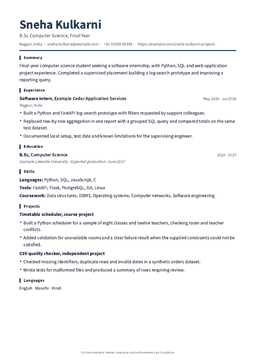
Fictional example: Computer science graduate, 2026, Example Institute. Built a small equipment-booking application using Python and SQL, including validation for overlapping bookings. Seeking a junior software role.
Compare with the standard opening: "A hardworking fresher seeking a challenging role in a reputed organisation to utilise my skills and grow with the company." That sentence is generic, gives the reader little evidence and uses space that could introduce your relevant work.
Writing a project so it reads as work
For a project, explain the problem, your contribution, the tools and the result or limitation. Keep a classroom exercise distinct from a system used by real customers.
Weak: Final-year project: equipment-booking application. Technologies: Python, SQL.
Stronger fictional example: Equipment-booking application, final-year project, August 2025 to March 2026. Built a prototype for reserving shared lab equipment using Python and SQL. Added checks for overlapping requests and wrote tests for cancelled bookings. Demonstrated the workflow with synthetic records; the project was not deployed to the university’s live systems.
The second version identifies a concrete engineering problem, testing and the project’s limits. It gives an interviewer specific work to discuss without claiming production experience.
A few relevant projects with clear explanations are more informative than a long list of titles.
Internships: write them as jobs
An internship belongs in a work-experience-shaped section, with company, title, location and dates, not in a list of certificates.
Weak: Completed a six-week internship at Example Analytics.
Stronger fictional example: Data Analyst Intern, Example Analytics, May to June 2025. Cleaned transaction records for a supervised reporting exercise, documented missing fields and compared the output totals with the source. Prepared a short handover note explaining the checks and unresolved exceptions.
If your internship was mostly shadowing, say what you observed and what you produced from it. A short, honest, specific line beats a padded one.
No internships at all
If you have no internship, use relevant coursework or a practical exercise you can complete and explain honestly. Do not relabel a simulation as employment.
Build a small example in your field, such as a reporting workbook, an application or a written analysis. Share it only when you have permission to publish the data and materials.
A volunteer or community project can also provide relevant experience. Agree on the work and permission to describe it, and label unpaid or volunteer work accurately.
A course with a completed practical assignment can show how you applied the learning. Choose relevant evidence rather than listing every course you have taken.
Finish and review the work before adding it to the resume. The time required depends on the project; a short deadline is not evidence that a project is useful.
Education, marks, and when they come off
Place education prominently when it is central to the application. Relevant employment or project evidence can come first when it is more useful to the reader.
List the qualification, institution and completion or expected completion date. Include marks or CGPA when requested or relevant, with the scale and status stated accurately.
Include school qualifications when the application requires them or they are your most relevant completed education. Do not assume every off-campus resume needs Class 10 and Class 12 marks.
- Relevant coursework only when it is genuinely relevant and specific. "Data Structures, Operating Systems, DBMS" for a software role, yes. A list of twenty subjects, no.
As your relevant experience grows, shorten older education details where appropriate. There is no fixed number of years after which every applicant must remove marks or school entries.
Campus placements: the same resume, with three differences
Campus processes may specify a shared format or additional fields. Read your own placement instructions before preparing the application.
- Use the placement cell's format when it is mandatory. Some cells require a fixed one-page template with a photograph and a roll number. When it is mandatory it is mandatory. Keep a second, clean version for off-campus applications and internship conversions.
If a process asks for marks, backlogs or other eligibility information, answer those fields accurately. Do not assume a resume presentation choice can override an eligibility requirement.
Adapt the evidence to each vacancy while keeping dates, qualifications and job history consistent.
Sit-out rules, dream-offer policies and how many companies you can appear for vary by institution. Read your own cell's rules before you plan.
Skills, without inflating them
Group them, keep them honest, and expect to be asked about every one.
> Languages: Python, SQL, Java > Libraries: pandas, NumPy, scikit-learn > Tools: Git, Excel, Power BI
List skills at a level you can demonstrate. If a tool was used only in coursework, be ready to explain that context rather than presenting it as extensive professional experience.
Include document formatting, email handling or measured typing speed when those tasks are relevant to the vacancy; describe what you can actually do.
The LinkedIn headline that matches
A clear LinkedIn headline can help a recruiter understand your field and experience. Use relevant role terms without assuming a particular search-ranking formula. A headline that only says "Student at [College]" gives limited information about your target field.
A headline that works has the role you want, your evidence, and your status:
Fictional headline: Final-year computer science student, Example Institute | Python and SQL projects | Seeking junior software roles
Fictional headline: B.Com graduate | Accounts-payable internship | Excel and Tally | Seeking accounts assistant roles
Avoid a headline that only says you want an opportunity. Add a relevant field and evidence, without claiming you already hold the role you are seeking.
Keep your LinkedIn consistent with the resume, use the same job titles and dates, and put the customised LinkedIn URL in your resume header as plain text.
Details to review before sending
A photograph: include one only when appropriate to the specific application requirements.
Unnecessary personal information: avoid identity numbers and unrelated family details in a generally circulated resume.
A declaration or signature: follow a prescribed form when required; otherwise use the space for relevant evidence.
A references statement: usually unnecessary unless requested.
Interests: include them only when they add useful context for this application.
- A skills bar chart claiming 80% proficiency in anything.
- Extra material that repeats information or does not help the application. Aim for a concise first resume, often one page, while following the actual application requirements.
The reasoning behind each of these is in the personal details guide.
Check it before placement season
Run the file through the free resume review before you send it anywhere. It provides feedback on the supplied resume, including section quality and project wording. It does not reproduce every employer's screening system, and you should check AI feedback before using it. Review the current access options before starting.
Then compare against a published example in your field: the resume samples library has fresher samples across engineering, commerce, IT, pharmacy, teaching and BPO roles, and the freshers hub collects the fresher-specific tools in one place.
A complete resume example with no work experience
The following fictional example shows how someone with no employment history can present real types of learning and activity. Aisha Sen, the institution and all project details are invented for illustration. Do not copy the name, dates or achievements into your own application. Use the structure to identify equivalent evidence from your life.
Aisha Sen | Pune | aisha.sen@example.com | Portfolio available on request
Profile: B.Com graduate applying for an operations assistant role. Practised spreadsheet checking and expense tracking through academic work and a student society project. Comfortable organising records, checking differences and explaining what needs attention.
Education: B.Com, Example College, Pune, 2026. Relevant study: financial accounting, business communication and quantitative methods. Include marks when the application asks for them or when they strengthen the application; use the institution's actual grading scale.
Project: Student society expense tracker, January to March 2026. Created an Excel workbook to categorise receipts and compare spending with the committee's budget. Used lookup formulas to match receipts with payment records and flagged entries that needed a clearer description. Prepared a short handover note so the next treasurer could continue the tracker.
Academic exercise: Retail inventory analysis, September to November 2025. Cleaned a fictional stock dataset supplied for coursework, standardised product categories and produced pivot summaries of stock movements. Documented missing values and explained how they affected the report. Presented the findings with classmates, identifying which parts were individual work and which were shared.
Activity: Registration volunteer, college careers event, February 2026. Checked registrations against the attendee list, explained room changes and passed unresolved queries to the event coordinator. Helped update the check-in sheet after duplicate registrations were found.
Skills: Excel formulas and pivot tables; record checking; expense categorisation; written handover notes; English and Hindi. Training: introductory spreadsheet reporting course, completed July 2026, with a practice workbook.
Why this example does not need an invented job
The project and activity sections show what the candidate did, which tools were involved and how she checked her work. They do not suggest she was an accountant, operations manager or paid consultant. The coursework dataset is labelled fictional, so the reader will not mistake a learning exercise for commercial data analysis.
The example also avoids invented efficiency percentages. It explains the output and its purpose. If you have measured an improvement with a sensible before-and-after comparison, you can report it. If you have not, describe the completed work, the people involved or the problem addressed. A credible explanation does not need a dramatic number.
What if you have no projects to list?
Choose one small task related to the job and complete it before adding it to your resume. For an office role, create a tidy booking register with validation and a short user guide. For a content role, write a small portfolio of original articles for a defined audience. For a junior data role, analyse an openly available dataset and document the limitations.
Keep the scope manageable enough to finish and explain. A half-built application described as a complete platform is less useful than a small working feature with clear notes. You can show a private demonstration or anonymised case study when public sharing is inappropriate. Do not expose another person's personal information to make your portfolio look realistic.
First resumes for school students
If you are sixteen or applying before university, replace the degree section with your current school qualification and expected completion date. Relevant activities might include helping at a school event, caring responsibilities that developed organisation, a club project or a supervised work experience placement. You can describe useful tasks without presenting personal circumstances you prefer to keep private.
Apply only for work you are eligible to do, and follow the employer's requirements for age, working hours and any necessary consent. These requirements vary by country and role. A resume example is not guidance on permission to work. Ask a school careers adviser or check the appropriate official local guidance when eligibility is unclear.
Tailor one version for one type of role
For Aisha's fictional operations application, spreadsheet checking and the event registration activity belong near the top. If she applies for an accounts assistant vacancy, the expense tracker and relevant accounting study deserve more detail. The underlying facts remain the same; the order and emphasis change.
Read the vacancy for tasks rather than collecting keywords alone. Does the role involve responding to customers, checking records or preparing reports? Select the evidence that shows those tasks. A skills shortlist can help you name capabilities, but it cannot establish that you have them. Keep a brief interview example for each skill you retain.
Format and market differences
A concise page is a useful starting point for a first resume, but follow the actual application requirements. A placement cell may mandate its own format. A UK vacancy may request a supporting statement as well as a CV. A US employer may use a resume and separate application questions. Avoid adding a second document simply because a template includes one.
Do not assume school marks, photographs or personal details are always required across a whole country. Read the instructions for the particular application. The personal details guide helps you think through what to include, and the freshers hub brings together relevant examples and tools.
Check the final document as a reader
Open the exported file, select the text and check that names, dates and headings appear in a sensible order. Confirm that links work and that the file opens without a password. Read every claim aloud: could you explain where it came from in an interview? Correct unclear wording before spending time changing decorative details.
Use the CareerOS resume builder when you want to assemble the evidence into a document. Review its current access and purchase options, and check the final output yourself. A clear first resume supports your application; it does not replace role eligibility, application instructions or an honest conversation about what you have learned.