Resume Format in India: Sections, Examples and File Checks
Choose a clear resume format for an India application, with sections for freshers and experienced candidates and exceptions for prescribed forms.
For a general corporate application in India, a clear reverse-chronological resume is a practical starting point. Put relevant evidence first, use readable text and follow the employer’s file instructions. There is no page count, font or layout that guarantees an interview or correct parsing in every system.
This guide concerns applications in India. A government notice, academic vacancy or overseas employer may request different information or a prescribed form. Read those instructions before adapting a general template.
A structure for an experienced applicant
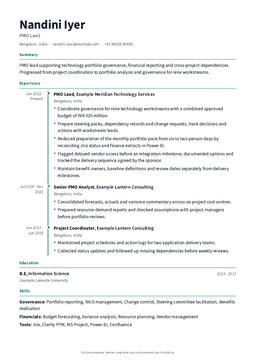
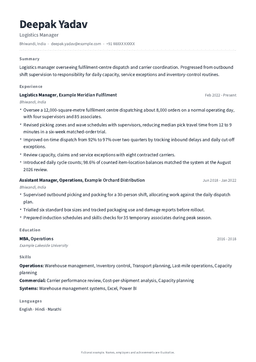
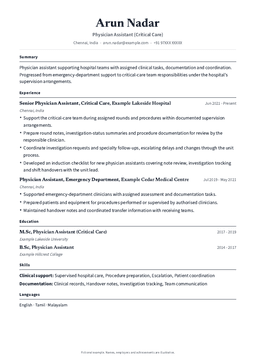
Start with your name, phone, email and a useful location. Add a maintained professional profile or portfolio when relevant. Follow with a short summary if it helps explain your fit, then recent experience, education and relevant skills or qualifications.
For each role, show the employer, accurate title and dates. Use concise bullets that explain what you did, with methods, scale or outcomes where you can support them. Older work can be shorter when it contributes less to the target application.
A structure for a fresher
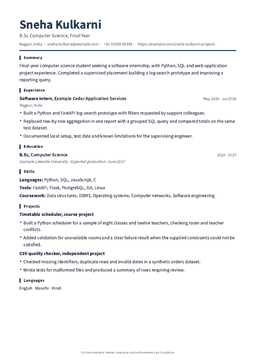
Education, relevant projects and placements may need to appear before employment history. Label each setting accurately. A final-year project can demonstrate analysis, design or teamwork without being described as a client engagement.
Fictional project entry: “Stock-record reconciliation exercise, Example College, 2026. Compared a mock stock register with count sheets in Excel, identified unmatched movements and documented assumptions for the course review.” The wording shows the task and learning context without inventing commercial responsibility.
Choose length based on useful evidence
Aim for a document that is easy to review. Many early-career applicants can present relevant evidence on one page; experienced applicants may need more space. These are practical choices, not rules triggered by an exact number of years.
If a page is mostly repetition, remove or combine it. If shortening requires tiny text or deleting relevant work, reconsider the length. A research CV, publication list or prescribed application may have a different purpose from a concise corporate resume.
Use readable formatting and test the file
Choose a readable font, consistent spacing and clear headings such as Experience, Education and Skills. Keep essential information as text. A simple layout reduces the number of things you need to check, but no template label proves compatibility with an employer’s software.
After export, inspect page breaks and copy the text into a plain text editor. Check contact details, dates and reading order. Follow the portal’s accepted file types and review its autofilled fields. Use a descriptive filename such as Asha-Rao-Resume.pdf.
Decide which personal details belong
For a general resume, name and professional contact information are usually a sufficient starting point. Do not add passport or national identity numbers, financial details or family information merely because an old template includes them. Consider whether a photograph or other personal detail is actually requested and appropriate for the application.
Some official applications require details in a prescribed form. Provide them through the legitimate requested process rather than placing every item in a resume you circulate widely. Check the employer and destination before sharing sensitive documents.
Use accurate qualification and skill descriptions
Write the degree or qualification name, institution and completion or expected-completion date accurately. Include marks when requested or when relevant to an early-career application. Do not describe an incomplete qualification as awarded.
List skills you can explain through tasks. “Excel: reconciled mock invoice data using lookups and pivot tables” is more informative than “MS Office expert” when it reflects your actual work. A course certificate and professional experience are different kinds of evidence.
Adapt without contradicting your history
Reorder relevant bullets and clarify the summary for a vacancy, but keep job titles, dates and qualification status consistent. If the employer asks for a CV, inspect the requested content rather than assuming the word always means an academic document.
Compare the final resume with the application form and any cover letter. The documents should describe the same person and timeline. Use the sample library for examples of structure and explanation, then replace every fictional detail with your own facts.