Resume Mistakes: A Practical Review and Correction Guide
Check resume accuracy, relevance, readable exports and weak bullets with concrete before-and-after examples and a final submission checklist.
A resume can be accurate but difficult to read, polished but irrelevant, or concise but missing evidence. Review those problems separately. This guide does not claim that five mistakes explain most rejections or that one formatting choice determines an employer’s decision.
Start with the vacancy and the exact file you intend to send. The examples below are fictional illustrations of editing choices, not achievements to copy into your own work history.
Check facts before improving the wording
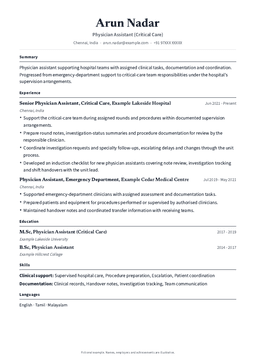
Compare role titles, employers, dates, qualifications and contact details with your records. If a title does not explain the work, add a short accurate description of scope rather than replacing it with a more senior title. Label placements, volunteer work and training projects clearly.
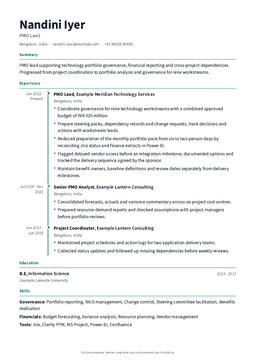
A team result can belong on your resume if your contribution is clear. “Led a department-wide migration” is misleading if you tested one report. “Tested the sales-report outputs during a department-wide migration and documented discrepancies for the project lead” describes useful work without changing your role.
Replace vague statements with specific work
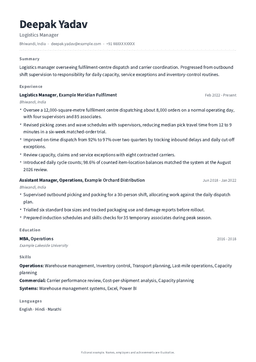
Before: “Responsible for customer service.” After: “Handled email queries about order changes, checked the order record and passed refund exceptions to the support lead.” The revised version names the channel, task and boundary of responsibility. It does not need an invented satisfaction score.
Words such as “assisted” are not automatically wrong. If you assisted an audit team, explain what you did: “Assisted the audit team by matching supplier invoices to the requested evidence list.” Change the content when it is vague, not merely because a verb appears on a banned-word list.
Choose evidence relevant to the vacancy
Read the essential duties and qualifications, then identify where your document supports them. Move relevant evidence into a visible position and remove repetition. If a requirement is a genuine gap, do not hide it with a matching keyword.
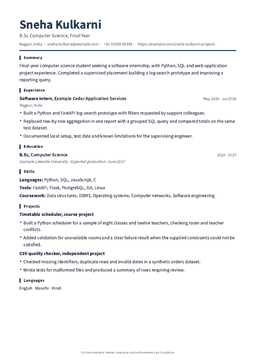
For a role involving reporting, a specific analysis project may be more useful than several generic personality claims. For an operational role, a careful handover or reconciliation task may matter more than an unrelated course. The correct choice depends on the work advertised.
Inspect the exported document
Check that text is readable, links work and important details are not cut off. Copy text from the PDF into a plain text editor to look for missing content or confused order. This is a practical check, not a simulation of every ATS. Review any fields the employer’s application form fills automatically.
A second page is justified when it carries relevant evidence. Avoid an orphaned heading or a single line on a final page, but do not shrink text until it is uncomfortable to read just to reach an arbitrary page count. Academic and specialist applications may require a different document.
Remove details that do not help this application
For a general job-search resume, start with name, professional contact details and a useful location. Add personal information only when it is relevant and appropriately requested. A prescribed government or regulated application can have different requirements, so follow its official instructions.
Remove generic objectives, repeated skill claims and empty sections. Keep a relevant interest or volunteer activity when it offers useful evidence. Do not delete every early job automatically if it explains experience the target role needs.
Make numbers explainable
A number should have a defensible source and definition. “Reduced processing time by 30%” invites questions about the baseline, period and your role. If you cannot support the comparison, describe the work and output accurately instead.
For a supported fictional example, reducing a task from 10 hours to 7 hours is a 30% reduction: (10 minus 7) divided by 10. A change from 70% to 80% is ten percentage points, not ten percent. Use the wording that matches the calculation.
Review the final submission
Confirm the requested file type, filename, attachment, contact details and role reference. Remove comments and tracked changes from an editable document. Test portfolio links without relying on your own logged-in access. Save the submitted version so your interview preparation matches the application.
ResumeGuru can offer feedback, but you remain the source of truth for your experience. Review AI edits for changed dates, inflated ownership, invented tools and unsupported outcomes before using them.