Tell Me About Yourself: Sample Answers for Experienced Professionals
A 90-second structure for experienced candidates, three fictional sample answers, and what to leave out when you have years of work to choose from.
The interviewer has your resume open. They do not need it read back to them. When you have eight or ten years of work behind you, the risk with tell me about yourself is not having too little to say. It is trying to say all of it.
For an experienced professional, a strong answer runs 60 to 90 seconds and has three parts: what you do now, one or two results that match this job, and why this role is the right next step. Your school, your first job and your family belong in it only when they connect to the role you are interviewing for.
How to answer tell me about yourself with experience
Think of the answer as present, proof and next. Each part has one job.
- Present. Your current title, the kind of organisation and what you are responsible for, in one or two sentences. "I manage a team of six" tells the interviewer more than "I am a dynamic leader".
- Proof. One or two results that match the job description. Pick results you can explain in detail, because the interviewer will ask follow-up questions about whatever you mention.
- Next. Why this role makes sense now. Connect it to what you have done, not to what you want to escape.
Spoken at a normal pace, 150 to 200 words takes about 60 to 90 seconds. If your answer is longer, cut the oldest material first.
Three sample answers for experienced professionals
The people, companies and numbers below are fictional. Use the structure, not the words.
Operations manager with nine years of experience
I am an operations manager at a regional warehousing company in Pune, where I run two sites with 85 staff. I joined as a shift supervisor in 2017 and took over both sites in 2022. In the last two years my focus has been accuracy. We moved stock counts from paper to handheld scanners, and dispatch errors fell from about 2 percent of orders to under 0.5 percent. I also rebuilt the shift roster after we lost two supervisors in one quarter, which brought overtime down without missing dispatch deadlines. I am interested in this role because you run six sites and are standardising processes across them. That is the work I have been doing at a smaller scale, and I would like to do it across a larger network.
Software engineer moving from a services company to a product company
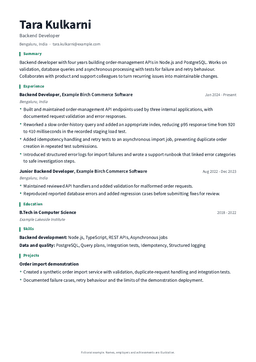
I am a senior software engineer at an IT services company, where I have spent five years building backend systems for banking clients, mostly in Java and Spring Boot. On my current project I own the payments reconciliation service. Last year I rewrote its batch job, and a nightly run that took four hours now finishes in under forty minutes. Client work taught me to write clear documentation and to handle changing requirements. What I want now is to own a product over a longer period and see how users respond to what I build. Your team's work on merchant settlements is close to what I do today, which is why this role stood out.
Teacher moving into corporate training
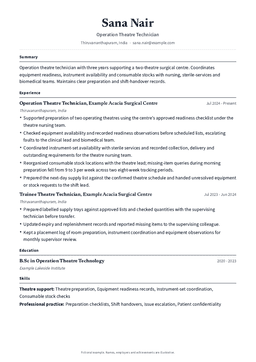
I have taught physics to senior secondary students for seven years, and for the last three I have also trained new teachers at my school. I designed our induction programme, which now runs every June for about 15 new staff, and I collect feedback after every session to revise it. The training part of my job is the part I enjoy most, and I have completed a certificate in instructional design to build on it. I am applying for this learning and development role because it is built around the skills I use every week: planning sessions, explaining difficult ideas simply and checking whether people can apply them.
Notice what each answer does. It names a role and its scale in the first sentence, gives one or two results with a number or a clear before and after, and ends on a reason that points at this employer.
What to leave out
- Your whole career in order. Start with your current role. Mention an earlier job only if it explains a skill this role needs.
- School marks and hobbies. After several years of work, they rarely help. The exception is a hobby that shows a skill the job uses.
- Complaints about your current employer. "I want to move because my manager does not value me" invites questions you do not want. Talk about what you are moving toward.
- Salary and notice period. These come up later. Answer them when they are asked.
- Claims you cannot support. If you say you "transformed" a process, expect to be asked how, by how much and what your part was.
Change the length for each round
The same story works in every round, at a different length.
- Phone screen with a recruiter. 30 to 45 seconds: your current role, your years of experience and why you applied. The recruiter is checking fit with the brief.
- Hiring manager. 60 to 90 seconds with your strongest result. This is where the full structure fits.
- Senior panel. Keep the length and change the results. Pick work that shows judgement: a decision you made, a trade-off you managed or a team you built.
If the interviewer says "walk me through your resume", that is a request for a longer answer. Take two to three minutes and go in order, still spending most of the time on recent roles.
Explain a switch, a gap or a long stay in one sentence
Interviewers often ask about these next, so one short line in your answer can save time.
- Career break. "I took 18 months off to care for a family member, and I have been back at work since March." Say it plainly and move on.
- Several short jobs. Link them: "Each move added one part of the work, from sales to account management to running the team."
- Ten years at one company. Show the growth inside it: "I joined as an analyst and have held three roles there, most recently leading the reporting team."
Practise it without memorising it
Write the answer once, then speak it from three notes: present, proof, next. A memorised script tends to sound recited, and one forgotten word can throw you off. Record yourself on your phone and time it. If it runs past 90 seconds, cut a detail, not a part.
Check that every result you mention is also on your resume, with the same numbers and dates. You can paste your practice answer into the free interview answer grader to see whether it shows evidence or only describes you. If you are early in your career, the fresher self introduction guide has one-minute examples built around projects and internships.
The answer works best when your resume tells the same story. Run a free resume review to see whether your results are clear on the page before the interviewer reads them.
Check your own material with the Free interview answer grader.